
“In Israel is the secret to the unity of the world.”
— Abraham Isaac Kook
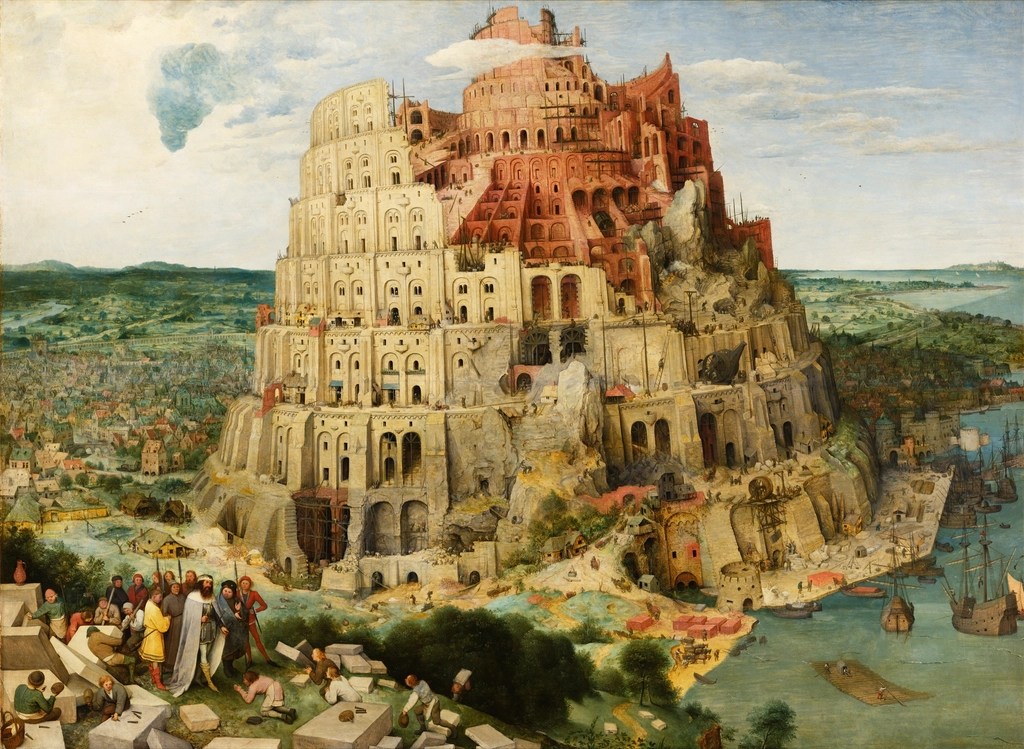
Babylon was the center of ancient civilization where many different tribes lived and engaged in idol worship, but there was a sense of camaraderie as the Babylonians were “Of one language and of one speech” (Genesis 11:1). However, it didn’t take long before society started to disintegrate under King Nimrod’s rule. The people kept wanting more for themselves and said, “Come, let us build us a city, and a tower, with its top in heaven, and let us make us a name” (Genesis 11:4).
The Tower of Babel became more important to people than anything else—including life. As Pirkey De Rabbi Eliezer writes: “They built it high … those who would bring up the bricks climbed up from its eastern side, and those who climbed down, descended from its western side. If a person fell and died, they would not mind him. But if a brick fell, they would sit and cry and say, ‘When will another come up in its stead?’”
The disregard and hatred for others was ubiquitous, and nothing could mend the rifts between people. Nimrod suggested that the only way to solve the problem was to disperse the population. He figured that everyone would stop fighting as long as they were at a distance. However, there was one Babylonian sage named Abram (later known as Abraham) who observed what was happening to his contemporaries. He came up with a different solution based upon his study of the oneness of nature.
Abraham discovered that the ultimate plan of Creation was for all of humanity to become connected through a network of goodness. Within that established unity, the Creator of the Universe could be revealed. Therefore, Abraham proposed that the only way to solve the problem was for people to connect above their individuality. Everyone’s uniqueness remained below, while love and concern for others covered all the differences.
Through regular lessons and the composition of books, Abraham and his wife, Sarah, began to educate anyone willing to learn. Although most of the Babylonians followed Nimrod, a distinct minority studied with Abraham. As Maimonides puts it, “he brought them back to the path of truth … thousands and tens of thousands assembled around him, and … he planted this tenet in their hearts” (Mishneh Torah, Part 1).
The majority of people who sided with Nimrod, abiding by the principle of advancing humanity through separation, became known as the nations of the world. The smaller group that followed Abraham, abiding by the principle of advancing humanity through unity, became known as the Jewish people. As Yaarot Devash states (Part 2, Drush No. 2), the term for Jew in Hebrew is Yehudi (יהודי), which comes from a similar word, Yichudi (יחודי), meaning united.
Nimrod expelled Abraham and his disciples from Babylon and they settled in Canaan, which would later become the Land of Israel. Abraham’s group called themselves Israel (ישראל), which the Ramchal explains is a term comprised of two words: Yashar and El (ישר א-ל), meaning “straight to God.” They were constantly trying to improve the connection above their growing egos by following the principle of “love will cover all transgressions” (Proverbs 10:12). Those loving bonds led them straight to the one force that guides all of reality—God.
This teaching was developed and passed down from Abraham to Isaac to Jacob and all the way to Moses, who, by that time, was tasked to lead a larger population. Following the exodus from Egypt, the newly freed Jewish slaves united as “one man with one heart” (Exodus 19:2, Rashi) at the foot of Mount Sinai and became worthy of receiving the Torah. Moses emphasized striving for love, bestowal and connection in order to merit divine revelation. The inner meaning of the Torah focuses on connecting with God by first uniting with others, which is why Rabbi Akiva taught that “love your neighbor as yourself” (Leviticus 19:18) is its guiding principle.
The nascent Jewish people was simultaneously tasked with being “a light unto the nations” (Isaiah 42:6). World peace eventually must occur, and God chose this unique group to be a role model through their example of harmony above discord. From that point forward, whenever there was divisiveness among Jews, antisemitism would increase for not fulfilling this mission; whenever there was unity, the hatred would decrease or even turn to admiration.
Following the entry into the Land of Israel and establishment of the first Holy Temple, sinful behavior among the nation’s leaders led to a schism and relatively brief exile. Most Jews adopted the selfish lifestyle of those kings and officers, while fewer heeded the call of the prophets for justice and kindness. After those remainders restored the commonwealth, Jewish brotherly love ebbed and flowed among the general population until it gradually declined into unfounded hatred. In fact, the Talmud (Yoma 9b) explains that this was precisely the reason for the destruction of the second Holy Temple and expulsion from Jerusalem.
The prolonged exile was actually all part of the plan of Creation. Jews began mingling with the nations of the world, which eventually produced two other major Abrahamic religions: Christianity and Islam. This enabled billions of people worldwide to recognize the importance of ethical monotheism. However, the final correction of human nature into altruism can only occur when the descendants of those who previously achieved such a transformation lead the way. As God told our ancestors, “Not only with you am I making this covenant and this oath, but … also with those who are not here with us this day” (Deuteronomy 29:13-14).
Unfortunately, our true Jewish calling has been lost. These days, there are factions of Jews focused on religious observance, while others are preoccupied with politics, and yet others fill their time with business or entertainment. We are each free to pursue our personal interests, but something of utmost importance must always remain above it all: connecting our hearts.
As Jews, our original vocation has never changed. Although we may be unaware of it, the nations of the world instinctively need an example of unity from us. The more that everything becomes interconnected—and at the same time people cannot adjust to such a paradigm due to divisive egotistical drives—the more that this demand will take the form of antisemitism. The same crisis that existed in Babylon is occurring today, but now it is clear that Nimrod’s method has exhausted itself; humanity is ready for Abraham’s method. The purpose of Creation must be fulfilled, and the world won’t leave us alone until we implement our ancestral remedy. Thus, our sages have provided the cure before the disease: real Jewish unity.
 Real Jewish Unity